
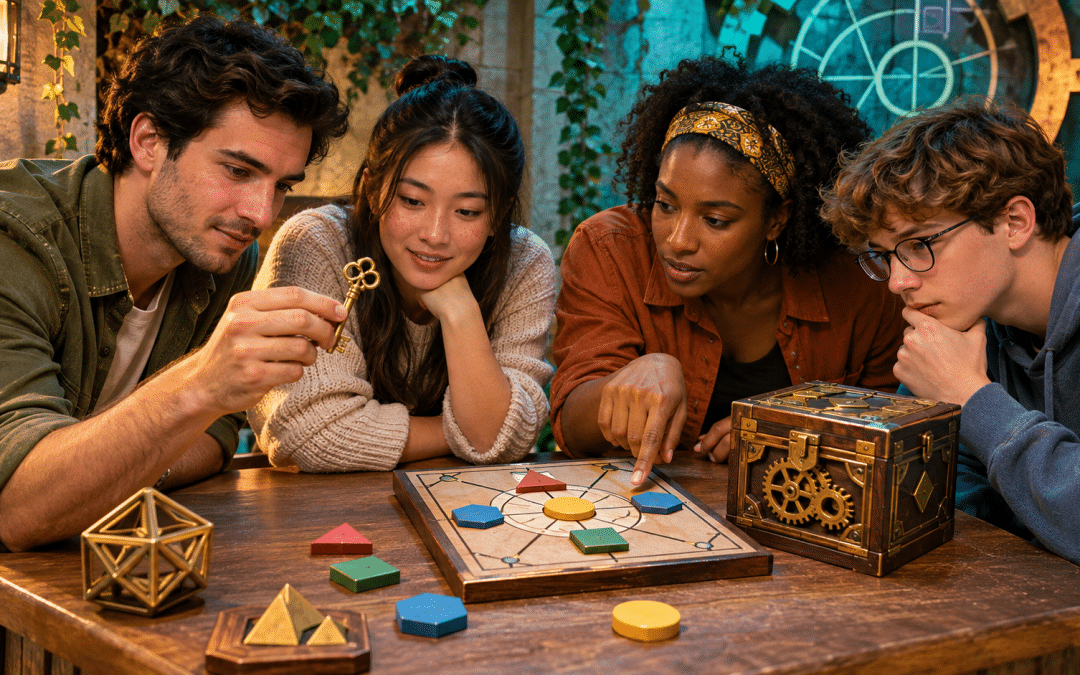
Every escape room begins with the same thrilling question: what matters here? A room may contain props, patterns, locks, sounds, lights, and story details, but the real challenge is learning which discoveries belong together. The best way to handle escape room clues is not to guess faster. It is to observe carefully, share everything, and test ideas as a team.
We have put together this spoiler-free guide to help first-time players and experienced teams recognize useful details, organize what they find, and keep moving when the clock is running. You will not find solutions to any of our rooms here, only a practical process you can use in almost any adventure.
What Counts as an Escape Room Clue?
A clue is information that points your team toward a puzzle, a method, or a next step. The puzzle is the challenge you must interpret, while the answer is the result you enter, arrange, unlock, or use. One object can sometimes play more than one role, so naming what you have found helps the team think clearly.
Common clue types include:
- Visual details: colors, shapes, symbols, pictures, or repeated design elements.
- Words and numbers: labels, dates, short messages, lists, or sequences that seem deliberately placed.
- Physical objects: keys, containers, movable props, or pieces that fit another part of the room.
- Position and order: the way objects face, line up, repeat, or change from one location to another.
- Sound and light: tones, flashes, or other feedback that confirms an action or suggests a pattern.
- Story information: mission details that explain what your team is trying to find, repair, recover, or complete.
Good escape room puzzle clues usually have context. A random number may mean nothing on its own, but a number beside a matching lock, diagram, or repeated symbol becomes worth testing. Your job is to connect evidence, not assign meaning to every decoration.
How to Spot Clues Without Overthinking the Room
Start with a calm, systematic search. Scan high and low within normal reach, open anything the game permits you to open, and tell the group what you notice. Repetition is especially useful: if the same color, symbol, shape, or object appears several times, it may be part of a pattern.
Also look for deliberate placement. An item that is centered, grouped, numbered, or positioned differently from similar objects may deserve attention. Interactive feedback can help too. A click, light, sound, open compartment, or other clear change often tells you that an action was correct.
At the same time, respect the boundaries explained during the game briefing. Do not force locks, dismantle furniture, climb, or handle anything marked as off-limits. If an idea requires strength or ignores a rule, it is almost certainly not the intended solution. Escape rooms reward observation and reasoning, not force.
How to Connect Escape Room Puzzle Clues
Finding items is only half the mission. The harder skill is seeing how separate discoveries interact. When teams ask us how to solve escape room puzzles more efficiently, we recommend a simple loop: share, sort, match, test, and update.
- Share every discovery out loud. A symbol that means nothing to you may complete a pattern another teammate is holding.
- Create a shared staging area. Place movable clues in one visible location so the team can compare them without repeating the search.
- Separate used and unused items. This prevents solved material from crowding the active puzzle. Follow any room-specific instructions about whether an item might be reused.
- Match outputs to inputs. A short number sequence may fit a keypad, a set of directions may fit a directional lock, and several shapes may correspond to marked positions elsewhere.
- Test one clear idea at a time. Explain the logic before entering an answer. If it fails, change one assumption instead of trying random combinations.
- Update the whole team. When something opens or changes, announce it immediately and reset priorities around the new information.
This process keeps the room from becoming a pile of disconnected observations. It also helps you notice when you are missing a piece. If three parts form a clear sequence but the fourth is absent, you now have a focused search target.
Team Roles That Make Clue Solving Easier
You do not need formal assignments, but flexible roles can prevent everyone from staring at the same puzzle. One person can keep searching, another can organize discovered items, and another can work through the active logic. A communicator can repeat important findings and make sure quieter teammates are heard.
Rotate when someone gets stuck. Fresh eyes are valuable because the next player approaches the same evidence without being attached to the first theory. In larger groups, avoid several side conversations that hide discoveries from the rest of the team. In a pair, narrate what you are doing so both players maintain the same picture of the room. Our guide to playing an escape room as a two-person team has more advice for dividing the search and managing the clock together.
When to Ask for Escape Room Hints
Using escape room hints is part of managing your time. Ask for help when the team has searched carefully, shared its findings, and tested the most reasonable connection without making progress. A good hint can point your attention toward the overlooked detail or relationship while leaving the satisfying final step to you.
Before asking, run a quick team check: What remains unused? Which locks or interaction points remain open? Has anyone found information that was never announced? If that review does not produce a new direction, take the hint and move forward. Spending a large part of the game defending one theory is rarely as fun as opening the next chapter of the mission.
Practice the Process in a Hamilton Escape Room
At our Hamilton Township location, we currently offer four themed adventures: Mockbuster, The Return of the Horseman, Game of Stones, and Star Ship. Each is listed as a private, 60-minute experience for 2–10 players, with different stories and published difficulty levels. You can compare our Hamilton escape rooms to choose the theme and challenge that fit your group.
You do not need special skills or previous escape room experience. Curiosity, communication, and a willingness to try another idea matter much more. We ask guests to arrive at least 15 minutes before the scheduled start so there is time to get ready for the adventure. Review our Hamilton escape room FAQs for current information about private rooms, arrival, ages, accessibility, reservations, and other visit details.
Frequently Asked Questions About Escape Room Clues
Are escape room clues always hidden?
No. Some clues are concealed, but others are visible from the beginning and become meaningful only after you find the information that explains them. Search carefully, but keep reviewing the obvious details too.
Can one clue be used more than once?
That depends on the game. Follow the briefing and any instructions provided in the room. Organizing solved and unsolved material is useful, but do not discard an object unless the game clearly tells you it is finished.
What should beginners do when they get stuck?
Pause and summarize. Gather unused items, list the remaining locks or interaction points, and have each player explain what they are trying. Then swap puzzles or request a hint if the team still has no clear next step.
Are hints allowed in an escape room?
Hint systems vary by experience, so listen to the game briefing for the exact process. In general, asking for help is a smart way to protect your remaining time when a focused attempt has stalled.
Do players need special puzzle-solving skills?
No special skills are required for our Hamilton escape rooms. Different people notice different kinds of details, which is why communication and teamwork are so valuable.
Put Your Clue-Finding Skills to the Test
The strongest clue-solving teams do a few things consistently: they search with purpose, announce discoveries, organize evidence, test ideas logically, and change direction when a theory stops working. Keep those habits in mind and every new object becomes easier to evaluate.
Ready to follow the trail? Gather your team, choose your story, and book a private Hamilton escape room with us. Your next clue is waiting.