
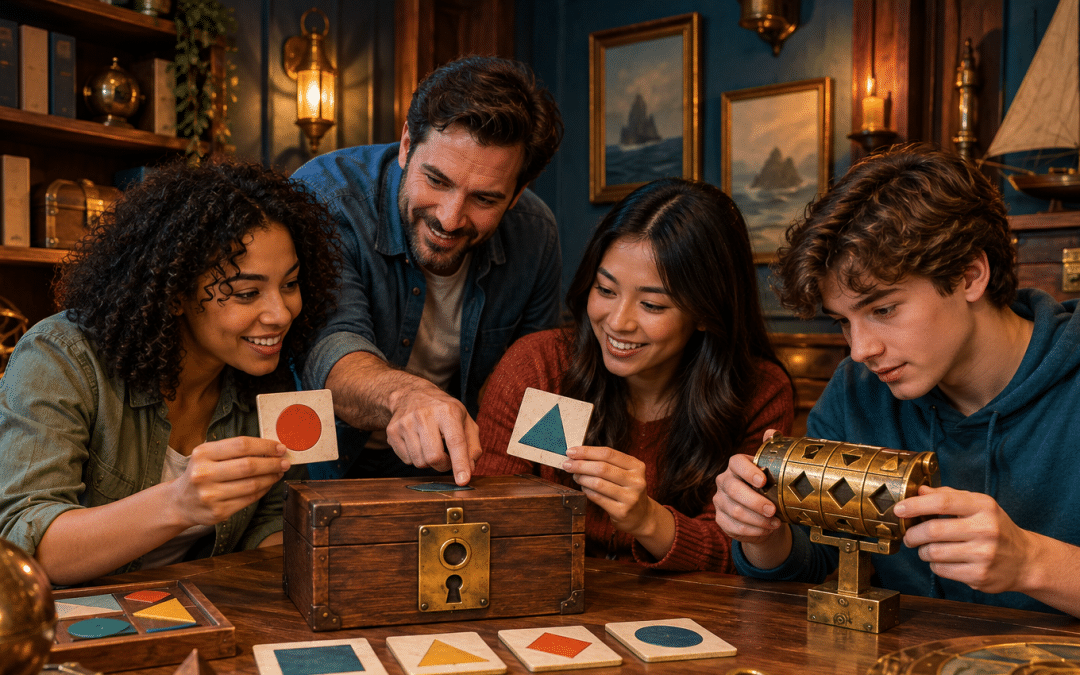
Escape room riddles can look mysterious, but most are built from a small set of recognizable ideas. A clue may ask you to notice a pattern, interpret a word, arrange objects, decode symbols, or connect information found in different parts of the room. The real challenge is rarely knowing an obscure fact. It is seeing what matters while the clock is running and sharing that discovery with your team.
This guide explains the most common types of escape room riddles, how to approach them, and what to do when your group gets stuck. It contains no room-specific spoilers, so you can build confidence without giving away the surprises inside an actual game.
What Counts as an Escape Room Riddle?
An escape room riddle is a clue that points toward an answer, an order, a location, or a next step. It may appear as a short question, a set of symbols, an unusual arrangement of objects, or a message hidden in the room’s story. Solving it often produces an output that fits another object: a word for a letter lock, a sequence for a directional mechanism, a count for a number lock, or a location where the next clue is waiting.
It helps to separate three parts of the challenge:
- The evidence: What the room has actually shown you, such as colors, shapes, words, positions, sounds, or repeated objects.
- The rule: The relationship that explains how to read or organize that evidence.
- The output: The answer format the next object requires, such as four letters, three numbers, or a specific order.
When a team identifies all three, an intimidating puzzle often becomes much more manageable.
8 Common Types of Escape Room Riddles
1. Wordplay and Language Riddles
These clues use definitions, double meanings, rhymes, missing words, acrostics, or unusual capitalization. A sentence may sound like ordinary story text while its first letters, last words, or repeated terms form the real message.
How to solve them: Read the clue aloud. Look for wording that feels unusually specific. Check beginnings and endings, repeated terms, line breaks, and words that can have more than one meaning. If the answer must fit a letter lock, count the available spaces before chasing a long phrase.
2. Number and Sequence Puzzles
Number riddles may involve counting objects, finding a progression, ordering dates, or translating visual information into digits. The arithmetic is usually less important than identifying which numbers matter and what order they belong in.
How to solve them: Write down the full sequence and compare the change between each item. Look for repeated intervals, mirrored pairs, grouped objects, or a story cue that determines the order. Do not assume every visible number is part of the same code.
3. Ciphers and Symbol Substitution
Ciphers replace letters or words with other characters. Common escape room versions use symbol alphabets, shifted letters, grids, paired shapes, or a decoder device found elsewhere in the room. The key is normally available inside the game.
How to solve them: Search for a legend, alphabet strip, matching symbol set, or repeated character. Start with short words and repeated patterns. Preserve spaces when possible because word length can reveal the structure of the message.
4. Visual Patterns and Hidden Details
Some escape room puzzle clues are meant to be seen rather than calculated. Colors may repeat in a deliberate order, a picture may contain an odd detail, or several objects may share a position or orientation. These challenges reward careful observation.
How to solve them: Change your viewing angle, compare similar objects, and describe exactly what is different. Ask whether the pattern communicates order, direction, quantity, or location. Avoid inventing meaning for decorative details until the room gives you a reason to use them.
5. Logic and Deduction Challenges
Escape room logic puzzles give several facts and ask the team to determine the only arrangement that satisfies them all. You might need to match people with objects, place events in order, or rule out impossible combinations.
How to solve them: Turn each statement into a simple fact. Create a small grid or row of possibilities, mark what cannot be true, and work from the most restrictive clue first. Keep facts separate from guesses so one early assumption does not derail the solution.
6. Spatial and Assembly Puzzles
These challenges use shapes, maps, tiles, physical pieces, or objects that must be aligned. The completed arrangement may reveal a silhouette, route, symbol, color order, or opening mechanism.
How to solve them: Sort pieces by edge, color, texture, or connector. Look for a frame that establishes the final size. Rotate pieces before rejecting them, and check both sides when the game permits it. Never force a component; escape room puzzles are solved through information, not strength.
7. Sound, Rhythm, and Sensory Clues
A tone, flashing light, vibration, texture, or repeating rhythm can carry information. These clues may translate into a count, a short-long pattern, or an order that corresponds to another prop.
How to solve them: Replay the sequence if possible and have different teammates focus on separate features. One person can count repetitions while another records pauses or changes. Say the rhythm aloud or tap it gently to make the pattern easier to remember.
8. Multi-Stage Combination Puzzles
Many escape room brain teasers combine two or more puzzle types. A cipher may reveal a set of objects, and the positions of those objects may produce a final number. A solved box may contain the key to interpreting a wall pattern. The first answer is not always the final answer.
How to solve them: After each breakthrough, ask what the answer fits. Keep solved items visible until their role is clear. If a result has the wrong format for every available input, it may be an instruction for the next stage.
A Repeatable Method for Solving Escape Room Riddles
- Inventory the evidence. Announce every meaningful object, symbol, key, color, and message. Put related items together when the rules allow.
- Identify the expected output. A four-letter lock needs a different answer than a directional pad. The input often tells you what the riddle must produce.
- Separate facts from assumptions. Write down what the clue definitely says before adding a theory about what it might mean.
- Test the simplest connection first. Escape room designers want the solution to feel fair. Try direct relationships before building a complicated interpretation.
- Communicate specifically. Instead of vaguely announcing a pattern, explain that four colors repeat from left to right. Precise language helps teammates connect clues.
- Track what has been used. Keep solved and unsolved materials in different areas. This reduces duplicate work and highlights clues that still need a purpose.
- Change perspectives when stuck. Hand the riddle to another teammate, revisit the mission, or compare it with unused inputs elsewhere in the room.
- Use hints strategically. A well-timed hint protects momentum. It is part of the experience, not a failure.
These habits also support the wider problem-solving and teamwork benefits of escape rooms. Different people notice different details, which is why a team that communicates clearly can outperform a group relying on one strong solver.
Common Mistakes That Waste Time
- Overthinking too early: Build theories from the evidence instead of making the clue fit an elaborate idea.
- Random guessing: Repeated combinations consume time and make it harder to recognize a real solution.
- Forcing objects: If a prop does not move with normal handling, stop and look for information that explains it.
- Hoarding clues: A discovery that seems meaningless to one player may complete another player’s puzzle.
- Reusing solved items automatically: Many props are used once. Keep them separate unless the room clearly connects them to a later step.
- Crowding one puzzle: Two people can work on the riddle while the rest search or organize other leads.
- Ignoring answer format: A beautiful theory is still wrong if it produces six letters for a four-letter input.
If your group worries that the puzzles will be too challenging, the official guide to how difficult escape rooms can feel for beginners offers a useful perspective: difficulty depends on the room, the group, and how well the team shares information.
How Different Players Can Contribute
You do not need a team of riddle experts. Strong groups use a mix of strengths:
- The observer notices small differences, hidden objects, and unusual placement.
- The organizer keeps keys, clues, and solved items from becoming a confusing pile.
- The word thinker hears double meanings and spots language patterns.
- The pattern finder recognizes sequences, symmetry, and repeated structures.
- The communicator connects discoveries from different parts of the room and keeps everyone informed.
- The fresh set of eyes approaches a stubborn clue without the assumptions that trapped the first solver.
Rotate roles naturally as the game changes. The player who struggles with a cipher may be the first to notice the spatial relationship that opens the next stage.
Practice Without Spoiling the Adventure
You can prepare for escape room riddles without searching for solutions to a specific room. Try short logic grids, simple substitution ciphers, visual matching games, tangrams, and cooperative tabletop puzzles. Practice describing discoveries out loud and letting another person restate the idea. That communication skill transfers directly into a timed room.
It also helps to understand the venue before you arrive. Review the current Coconut Creek escape room adventures to compare themes, published difficulty, duration, and group capacity. Choose a story your group will enjoy, because curiosity makes it easier to stay engaged when a clue demands patience.
Frequently Asked Questions About Escape Room Riddles
Are escape room riddles hard?
They are designed to be challenging, but difficulty varies. Most reward observation, communication, and persistence rather than specialized knowledge. A beginner can make important discoveries, especially when the team shares everything it finds.
Do players need to be good at math?
No. Some puzzles use numbers, but counting, ordering, matching, language, visual recognition, and teamwork are just as common. When arithmetic appears, the room normally provides the information needed to solve it.
Can beginners ask for hints?
Hint systems vary by venue and room. If your team has tested the available evidence and stopped making progress, asking for guidance can keep the experience moving. For practical arrival, reservation, and participation information, check the Coconut Creek visitor FAQ before game day.
Are riddles the same as puzzles?
Not exactly. A riddle usually communicates an answer through language, symbols, or indirect clues. A puzzle may also involve physical assembly, searching, manipulation, or several linked steps. In an escape room, the two often work together.
What should a team do when it gets stuck?
Stop repeating the same attempt. Gather unused clues, state the expected answer format, explain the current theory to a teammate, and let someone new try. If no fresh connection appears, use the room’s hint process.
Put Your Puzzle-Solving Skills to the Test
The best way to improve at escape room riddles is to enter the story, stay observant, and communicate from the first discovery to the final seconds. Your group does not need to solve every clue instantly. It needs to keep information moving and treat each dead end as a signal to change perspective.
Ready to gather your team? Compare the available adventures, choose a theme that matches your group, and book a private Coconut Creek escape room. The next clue is waiting.